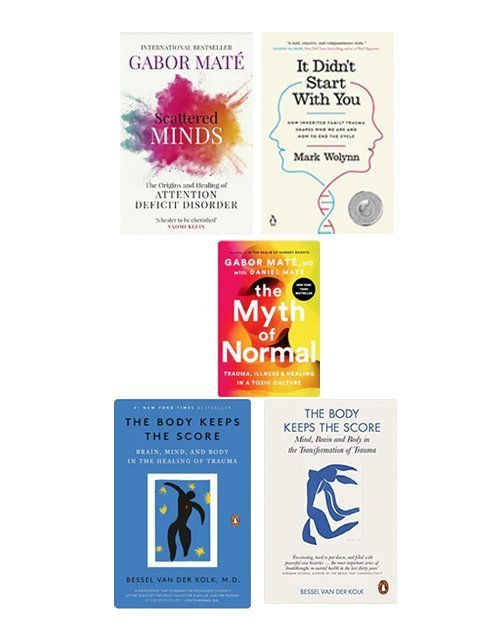
Scattered Minds || The Myth of Normal || It Didn’t Start with You || The Body Keeps the Score || By Bessel van der Kolk The Body Keeps the Score Mind Brain and Body in the Transformation of Trauma Paperback 5 book Combo
An explosive new approach to understanding and treating attention deficit disorder, Scattered Minds explodes the myth of ADD as a genetically based illness, offering real hope and advice for children and adults who live with this condition.
Gabor Maté is a revered physician who specializes in neurology, psychiatry and psychology — a completely unique outlook on ADD, as he has ADD himself. A powerful, groundbreaking book –from the internationally bestselling author of Obsessive Genius–about the impact of the birth of her second son on her mental, emotional, and professional life. Scattered Minds explodes the myth of ADD as a genetically based illness, offering real hope and advice for children and adults who live with this disorder.
Scattered Minds:
ADD is not an inherited illness but a reversible impairment and developmental delay
Describes how in ADD the circuits in the brain whose job is to regulate the flow of emotion, attention, and movement don’t fully develop from lack of nutrition for them in infancy – and why
Illuminates how ‘distractibility’ is the mental fallout of life experience
Enabling parents to get inside what makes their ADD children tick, adults with ADD to access a window into their emotions and behavior
Talks optimistically about brain growth even in adulthood
Depression. Anxiety. Chronic Pain. Phobias. Obsessive thoughts. The evidence is persuasive: the origins of these afflictions may not be in our immediate life experiences or in chemical imbalances in our brains, but in the lives, and even the genes, of our parents, grandparents, and great-grandparents.
New scientific research, making headlines has confirmed what many of us have long intuited: Traumatic experience can be passed down through generations. It Didn’t Start with You expands on the work of eminent professionals such as the author’s grandfather and one of the pioneering researchers in the field of epigenetics, as well as the work of the author’s own distinguished psychiatry professor, his fellow psychiatrists, neuroscientists, and current researchers in the field of psychotherapy.
Even if the person who was originally traumatized is dead, or that story has been lost or buried, memory and feeling can persist. Such emotional legacies may be hidden, encoded in everything from gene expression to everyday language, and yet they can play a much larger role in our emotional and physical health than has ever before been understood.
Trauma is a fact of life. Veterans and their families grapple alone with the pain, an aftermath of combat; one in five Americans has been molested; one in four grew up with alcoholics; one in three couples have engaged in physical violence. for more than three decades the psychiatrist Dr. Bessel van der Kolk has focused on the impact of treatments for survivors of trauma. In The Body Keeps the Score, he uses recent scientific advances, ranging from neuroimaging to psychobiology, to show how trauma literally reshapes both body and brain, compromising sufferers’ capacities for pleasure, engagement, self-control, and trust.
He investigates the new treatments that immediately stimulate the brain’s capacity for change, opening the way to overcome symptoms and release patients from their reliance on antidepressants, or other drugs that treat the same issues. Through bodywork, psychotherapy, theatrical performance, and more, you will gain practical understanding of